




Ipamorelin
Selective GH Secretagogue & GHSR Agonist – HPLC Verified
Comprehensive Product Description
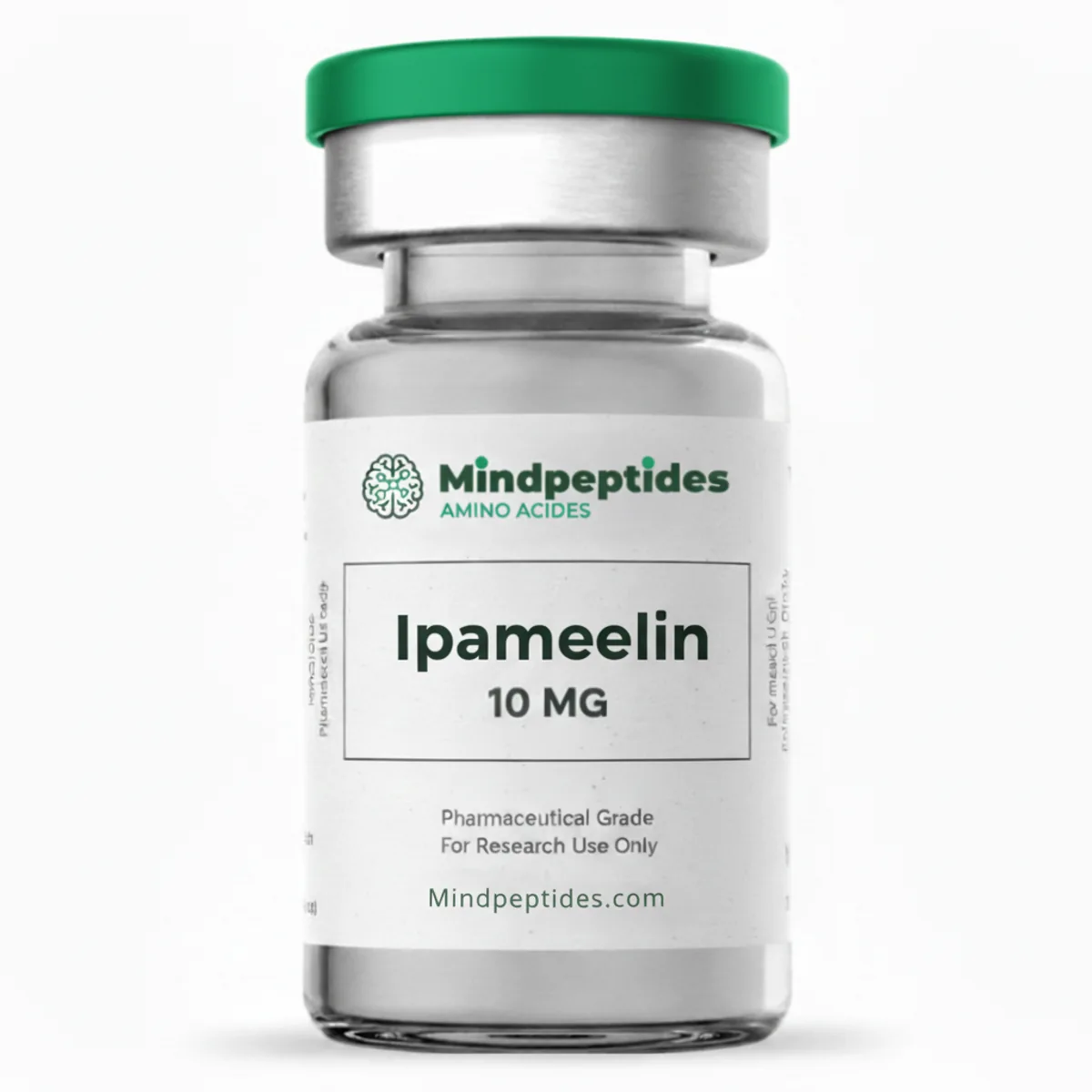
Ipamorelin is a synthetic pentapeptide and a highly selective agonist of the ghrelin/growth hormone secretagogue receptor (GHSR). Chemically distinguished by the sequence Aib-His-D-2-Nal-D-Phe-Lys-NH2, it belongs to the growth hormone-releasing peptide (GHRP) class. mindpeptides synthesizes this compound to facilitate research into pulsatile growth hormone (GH) dynamics without the confounding variables often seen with older generations of secretagogues.
Unlike GHRP-6 or GHRP-2, which can exhibit significant cross-reactivity with adrenergic or dopaminergic receptors, Ipamorelin demonstrates exceptional selectivity. In laboratory models, it stimulates somatotrophs to release GH without inducing significant concurrent spikes in adrenocorticotropic hormone (ACTH), cortisol, or prolactin. This “clean” pharmacological profile makes Ipamorelin the reference standard for researchers aiming to isolate the physiological effects of the GH-IGF-1 axis in a controlled environment.
Mechanism of Action & Signaling Pathways
GHSR-1a Activation & Signal Transduction
Ipamorelin acts as a potent biomimetic of ghrelin, binding specifically to the Growth Hormone Secretagogue Receptor 1a (GHSR-1a) located on the pituitary gland. This binding event triggers a G-protein coupled receptor (GPCR) cascade, specifically activating the phospholipase C (PLC) pathway.
The activation of PLC leads to the generation of inositol triphosphate (IP3) and diacylglycerol (DAG), causing the release of intracellular calcium ions (Ca2+) from the endoplasmic reticulum. This cytosolic calcium surge facilitates the fusion of GH-containing secretory vesicles with the cell membrane, resulting in a robust, pulsatile release of Growth Hormone. Subsequently, this elevates circulating levels of Insulin-like Growth Factor 1 (IGF-1) via hepatic synthesis, which mediates the downstream anabolic and reparative effects observed in tissue studies.
Expanded Research Applications
- Musculoskeletal Growth & Repair: Research utilizes Ipamorelin to investigate nitrogen retention and protein synthesis rates in skeletal muscle. It is frequently applied in models of catabolic wasting or post-surgical recovery to assess the role of the GH/IGF-1 axis in tissue regeneration.
- Bone Density & Mineralization: Studies focus on the peptide’s ability to stimulate osteoblast activity and collagen type I synthesis, providing data on potential interventions for osteoporosis and fracture healing dynamics.
- Metabolic & Gastric Research: As a ghrelin analogue, Ipamorelin is used to study gastric motility and energy homeostasis. While it influences the ghrelin pathway, researchers monitor it for its distinct lack of significant orexigenic (appetite-stimulating) properties compared to GHRP-6.
Laboratory Reconstitution Guidelines
mindpeptides supplies Ipamorelin as a lyophilized powder which requires proper reconstitution prior to use in assays.
- Solvent: Bacteriostatic water or sterile 0.9% NaCl solution is recommended.
- Procedure: Gently inject the solvent down the side of the vial. Do not shake vigorously. Allow the peptide to dissolve at room temperature or with gentle swirling to avoid destroying the peptide structure.
- Handling: Once reconstituted, keep the vial cold (4°C) if used within days, or freeze at -20°C/-80°C for long-term storage.


Reviews
There are no reviews yet.