







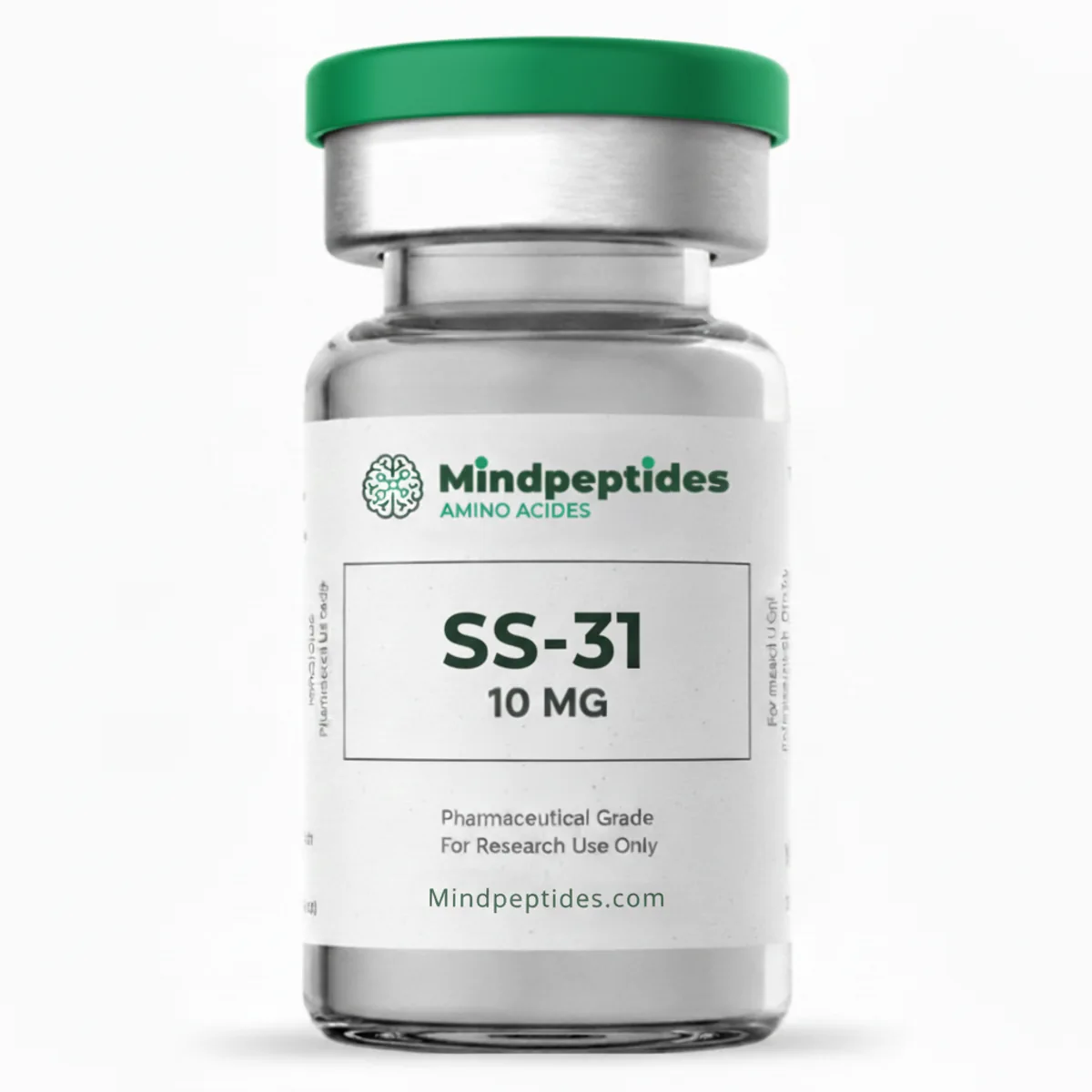
SS-31 (Elamipretide)
Mitochondria-Targeting Antioxidant & Bioenergetic Peptide – HPLC Verified
Comprehensive Product Description
SS-31 (Elamipretide), also referenced in literature as MTP-131 or Bendavia, is a cell-permeable, synthetic tetrapeptide belonging to the Szeto-Schiller (SS) family of antioxidant peptides. mindpeptides synthesizes this compound to support advanced investigations into mitochondrial bioenergetics. Structurally, SS-31 is a small, aromatic-cationic peptide designed with a specific alternating motif that allows it to penetrate cell membranes independently of membrane potential, subsequently localizing to the inner mitochondrial membrane (IMM).
The primary research significance of SS-31 lies in its unique affinity for cardiolipin, an anionic phospholipid essential for mitochondrial cristae architecture. By interacting electrostatically with cardiolipin, SS-31 stabilizes the lipid environment, thereby optimizing the function of the electron transport chain (ETC). Unlike general antioxidants that scavenge reactive oxygen species (ROS) throughout the cytoplasm, mindpeptides offers SS-31 as a precision tool for targeting the source of oxidative stress at the mitochondrial level, making it a critical reagent for studies involving ischemia-reperfusion, neurodegeneration, and metabolic signaling.
Mechanism of Action & Signaling Pathways
Cardiolipin Stabilization & ETC Efficiency
Upon entering the mitochondria, SS-31 selectively binds to cardiolipin via electrostatic interaction. Under pathological conditions or oxidative stress, cardiolipin is prone to peroxidation, which disrupts cristae structure and decouples the respiratory supercomplexes. SS-31 inhibits this peroxidase activity of cytochrome c, protecting cardiolipin from oxidative damage.
By preserving cardiolipin integrity, the peptide facilitates efficient electron transfer between Complex III and Complex IV (via cytochrome c). This optimization reduces electron leak, thereby significantly lowering the production of mitochondrial Reactive Oxygen Species (ROS) while simultaneously enhancing ATP synthesis. Consequently, this pathway modulates downstream inflammatory cytokines and reduces cellular apoptosis markers associated with mitochondrial dysfunction.
Expanded Research Applications
- Ischemia-Reperfusion Injury:
SS-31 is widely utilized in cardiac and renal models to study the mitigation of reperfusion injury. Research indicates it may limit infarct size and preserve organ function by preventing the mitochondrial permeability transition pore (mPTP) opening. - Neurodegenerative Disease Models:
In models of Alzheimer’s and Parkinson’s disease, SS-31 is investigated for its ability to reduce synaptic loss and neuronal oxidative stress, providing insight into the mitochondrial etiology of neurodegeneration. - Metabolic & Skeletal Muscle Research:
Researchers employ SS-31 to examine mitochondrial coupling efficiency in skeletal muscle, particularly in the context of aging (sarcopenia), insulin resistance, and fatigue, isolating the role of mitochondrial quality control.
Laboratory Reconstitution Guidelines
mindpeptides supplies SS-31 as a lyophilized powder which requires proper reconstitution prior to use in assays.
- Solvent: Bacteriostatic water, PBS, or sterile 0.9% NaCl solution is recommended.
- Procedure: Gently inject the solvent down the side of the vial. Do not shake vigorously. Allow the peptide to dissolve at room temperature or with gentle swirling to avoid destroying the peptide structure.
- Handling: Once reconstituted, keep the vial cold (4°C) if used within days, or freeze at -20°C/-80°C for long-term storage.




Reviews
There are no reviews yet.