





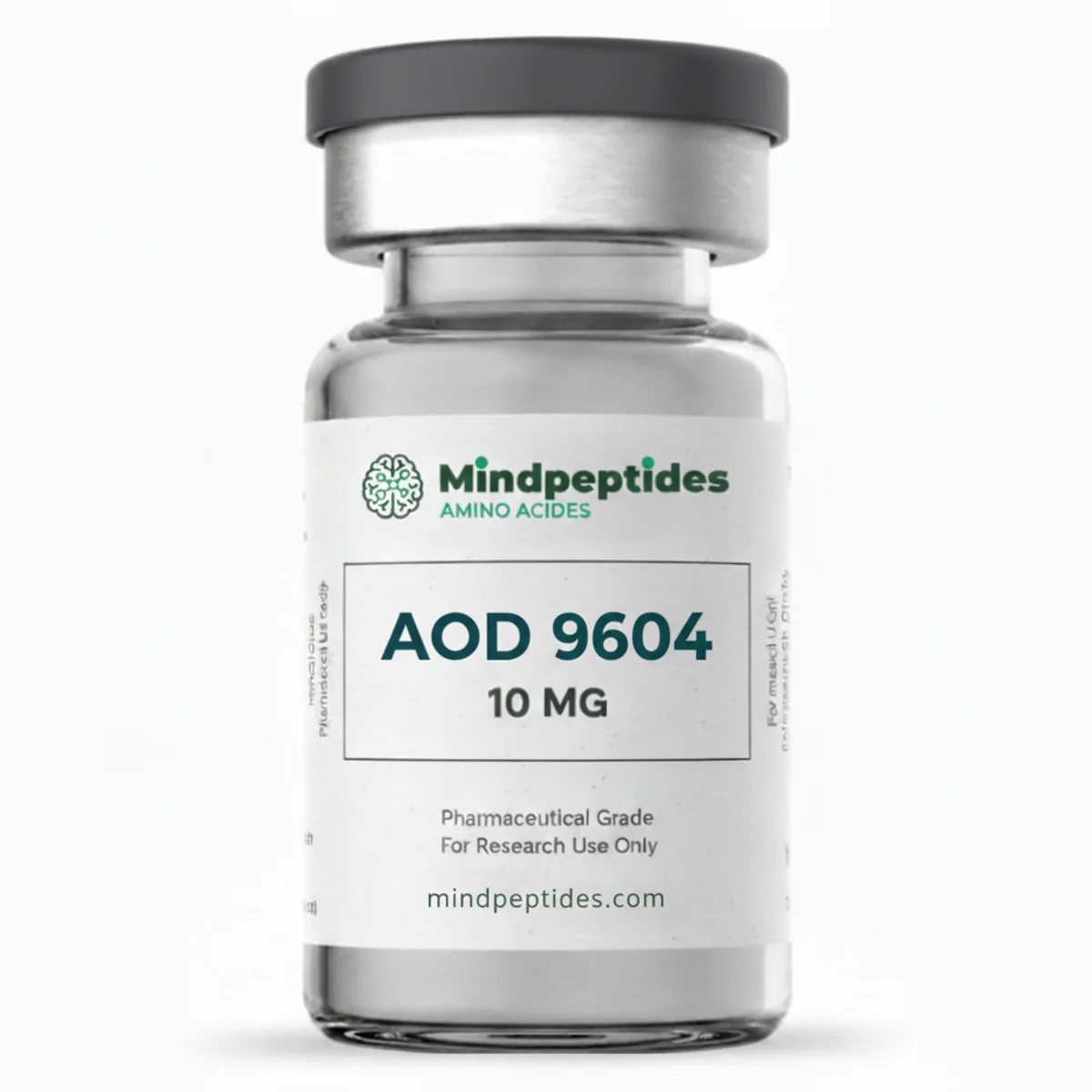
AOD-9604 (Metabolic Fragment 177-191)
Premium Lipolytic Peptide & Weight Management Support – HPLC Verified
Comprehensive Product Overview
AOD-9604 is a specialized peptide fragment derived from the C-terminal domain (residues 177-191) of human Growth Hormone (hGH), enhanced with an N-terminal tyrosine to ensure superior stability. Manufactured by mindpeptides, this formulation captures the potent fat-burning properties of hGH while deliberately excluding the regions responsible for insulin-like growth factor-1 (IGF-1) production and diabetogenic effects. It is a preferred choice in the wellness community for individuals seeking to optimize body composition and target stubborn fat stores without the side effects associated with full-spectrum hormones.
The efficacy of AOD-9604 lies in its precise molecular structure, stabilized by a disulfide bridge that mimics the body’s natural signaling mechanisms. Unlike traditional weight loss agents that may stimulate the central nervous system, AOD-9604 works selectively on adipocytes (fat cells). This targeted approach allows for efficient fat mobilization and metabolic regulation, making it an invaluable tool for weight management, cellular repair, and maintaining a lean physique without disrupting blood sugar levels or inducing hunger.
Mechanism of Action & Benefits
Lipolysis and Metabolic Efficiency
AOD-9604 facilitates a dual-action metabolic pathway to support leanness. Primarily, it stimulates lipolysis—the breakdown of stored triglycerides into free fatty acids—by interacting with beta-3 adrenergic receptors. This mimics the body’s natural response to intense exercise and fasting, effectively unlocking stored energy for utilization.
Simultaneously, the peptide inhibits lipogenesis, the metabolic process responsible for depositing new fat. By blocking the esterification of fatty acids, it prevents the re-accumulation of adipose tissue. Importantly, AOD-9604 achieves these results without elevating heart rate or blood pressure, offering a safe, non-stimulant alternative for enhancing metabolic rate and supporting long-term weight control goals.
Lifestyle & Wellness Applications
- Weight Management & Definition:Widely used to assist in the reduction of visceral and subcutaneous fat, particularly in stubborn areas like the abdomen, while preserving lean muscle mass during caloric deficits.
- Joint Health & Recovery:Research indicates that AOD-9604 may stimulate chondrocyte activity and proteoglycan synthesis, suggesting potential benefits for cartilage repair, joint mobility, and faster recovery from physical activity.
- Energy Optimization:By facilitating the oxidation of fats for fuel, it supports sustained energy levels and mitochondrial efficiency, aiding endurance and performance without the crash of sugar-based energy sources.
Suggested Use & Preparation
mindpeptides supplies AOD-9604 as a high-purity lyophilized powder requiring reconstitution to ensure maximum potency and bioavailability.
- Preparation: Reconstitute using Bacteriostatic Water or sterile 0.9% NaCl solution.
- Mixing: Slowly inject the diluent into the vial, aiming against the glass wall. Swirl gently to dissolve; do not shake vigorously to protect the delicate peptide structure.
- Storage: Once mixed, the solution must be kept refrigerated at 4°C and used within 14-21 days. Unmixed vials can be stored in the freezer for long-term stability.
AOD-9604 (Tyr-hGH Frag 177-191)
Selective Lipolytic Peptide & Metabolic Research Agent – HPLC Verified
Comprehensive Product Description
AOD-9604 is a synthetic peptide analog representing the C-terminal domain (residues 177-191) of human Growth Hormone (hGH), structurally modified with an N-terminal tyrosine residue. Produced by mindpeptides, this peptide is engineered to isolate the lipolytic (fat-burning) attributes of hGH while systematically excluding the polypeptide regions responsible for diabetogenic effects and insulin-like growth factor-1 (IGF-1) secretion. The addition of the tyrosine residue enhances the chemical stability of the molecule, preventing rapid degradation during in vitro analysis. This specific fragmentation allows for the dissociation of energy metabolism from cellular proliferation, a critical distinction for researchers investigating metabolic syndrome.
The structural integrity of AOD-9604 relies on a disulfide bridge between cysteine residues, maintaining a cyclic configuration essential for its biological receptor affinity. Unlike full-length hGH, which exerts broad physiological effects across multiple organ systems, AOD-9604 demonstrates high specificity for adipocytes. This selectivity makes it an invaluable tool for in vitro and in vivo models focusing on obesity, lipid metabolism disorders, and connective tissue repair, as it mimics the fat-releasing action of growth hormone without interacting with the hGH receptor’s growth-promoting domains or inducing hyperglycemia.
Mechanism of Action & Signaling Pathways
Lipolysis and Inhibition of Lipogenesis
AOD-9604 functions through a dual mechanism in adipocyte signaling. Primarily, it stimulates lipolysis (the breakdown of stored triglycerides into free fatty acids and glycerol) by modulating the activity of hormone-sensitive lipase (HSL) and interacting with beta-3 adrenergic receptors. This pathway mimics the beta-oxidation signals usually triggered by fasting or exercise. Crucially, the peptide does not interact with the somatotropic axis, thereby avoiding the induction of insulin-like growth factor 1 (IGF-1) which is typically associated with the mitogenic properties of the intact growth hormone molecule.
Simultaneously, the peptide exerts an antilipogenic effect, inhibiting the pathway responsible for the esterification of fatty acids into new triglycerides (lipogenesis). This regulatory control helps prevent the accumulation of new adipose tissue. Unlike traditional beta-agonists, AOD-9604 does not induce significant heart rate elevation or blood pressure changes in animal models, suggesting a non-autonomic mechanism of action that remains a subject of intense investigation in metabolic research.
Expanded Research Applications
- Obesity & Metabolic Syndrome: Extensively used in rodent models to evaluate reductions in visceral adipose tissue and improvements in lipid profiles without inducing hyperglycemia or insulin desensitization.
- Cartilage & Connective Tissue Repair: Emerging research indicates AOD-9604 may enhance chondrocyte proliferation and proteoglycan production. It is currently being investigated for its potential in regenerative medicine, specifically for osteoarthritis and tendon repair models.
- Mitochondrial Function: Studies suggest downstream effects on energy expenditure markers, making it a candidate for researching mitochondrial efficiency and substrate utilization in skeletal muscle.
Laboratory Reconstitution Guidelines
mindpeptides supplies AOD-9604 as a lyophilized powder which requires proper reconstitution prior to use in assays.
- Solvent: Bacteriostatic water or sterile 0.9% NaCl solution is recommended.
- Procedure: Gently inject the solvent down the side of the vial. Do not shake vigorously. Allow the peptide to dissolve at room temperature or with gentle swirling to avoid destroying the peptide structure.
- Handling: Once reconstituted, keep the vial cold (4°C) if used within days, or freeze at -20°C/-80°C for long-term storage.


Reviews
There are no reviews yet.